Modus: Fingerprinting Adversaries by Their Decisions and Why We Publish It
by Robin Dost
Today we publish the Modus whitepaper, version 0.9.
Modus is a method for fingerprinting threat actors by the decisions they keep making: which registrar they use, which TLDs they pick, when they work and how long a fresh domain sits before it goes live.
This post covers why we publish it, where it sits in the Malwarebox ecosystem and what follows.
It is the first of three: Modus today, then MB-RM, then PELAGIC.
After that the models move into a platform where you can use them on real actors.
If you have followed this blog, you already know IIM and IIMQL and ACDP and SOLBIT got a first look in an earlier post.
Why this matters now
Attribution has always leaned on artefacts that were expensive to produce. A custom loader, a reused code base, a config format only one group uses, the typical language mistakes in a phishing lure.
Rebuilding those took time and skilled people, so they stuck around long enough to track.
That cost is collapsing.
With current models an actor can port a loader to another language in an afternoon, get fresh obfuscation for every campaign and write lures in fluent German, Ukrainian or Korean. Infrastructure comes up and goes down through scripts and agents.
Every campaign can ship with new code, new strings and new servers.
It works the other way round too. A model that can rebuild your own tooling can also imitate someone else’s. Coding style, comment language and typical mistakes used to be decent hints. Today they are one prompt away from a false flag.
Bianco’s Pyramid of Pain still holds, but the levels are moving. Tools used to sit near the top. With AI they slide down toward hashes and IP addresses, into the range where changing them costs an adversary almost nothing.
What changes slowly is the organisation behind the operation.
Somebody still pays for domains and needs a registrar that accepts that payment. A team still works shifts in a time zone. Procurement, risk appetite and habits come from people and budgets, and nobody regenerates those per campaign.
Agents can automate a registration as well. They still run on an account, a payment method and a decision about acceptable risk, made by someone who has been doing it the same way for years.
That is the layer Modus measures.
Attribution is a Holschuld
German civil law has a word for a debt the creditor has to come and collect: Holschuld.
The debtor waits at home. If you want what you are owed, you go and get it.
A lot of public attribution works exactly like that.
A report says an activity cluster “is assessed with moderate confidence” to belong to some actor.
The evidence behind that sentence, the reasoning that turned evidence into a claim and the reason it says “moderate” instead of “high” all stay with the author.
If you want them, you have to fetch them.
Usually you can’t, because they live in an internal wiki, a notebook or one analyst’s head.
What’s left is attribution by gut feeling.
Experienced analysts often have very good gut feeling.
It still doesn’t scale, nobody can review it and two teams looking at the same evidence end up with two names for the same thing.
Three failure modes show up again and again:
- Evidence gets summed instead of weighted. A planted string and a six-month working-hours pattern both count as “an indicator”. One costs minutes to fake. The other costs an adversary a whole shift schedule, sustained under pressure.
- Correlated evidence gets counted twice. A malware family and the config inside the same sample are one observation wearing two hats.
- “Same hand” and “whose hand” share one confidence verb. Clustering two intrusions to one operator is a much easier call than naming the sponsor behind them.
I’ll admit a bias here. I’m German.
When I see a process that runs on feelings, my first instinct is to write it down, version it and give it a form number. Attribution has been on that list for a while.
The models that are missing
We have plenty of frameworks.
ATT&CK describes what an actor does during an intrusion.
STIX moves intelligence between systems. The Diamond Model ties an event to adversary, capability, infrastructure and victim.
Rid and Buchanan’s Q-Model treats attribution as a process across technical, operational and strategic levels.
Bianco’s Pyramid of Pain ranks indicators by how much it hurts an adversary to change them.
All of these are useful and we build on them. None of them gives you an open, operational method: defined inputs, explicit rules and a versioned output you can rerun next year and get the same answer.
The papers tell you how to think about attribution.
Vendors have internal processes for merging and promoting clusters.
In between there is very little you can pick up, run against your own data and audit.
That gap is why Malwarebox builds models and publishes them.
IIM does it for infrastructure.
Modus does it for adversary decisions.
SOLBIT does it for attribution itself.
What Modus does
Modus fingerprints an actor by the structure of its operational decisions.
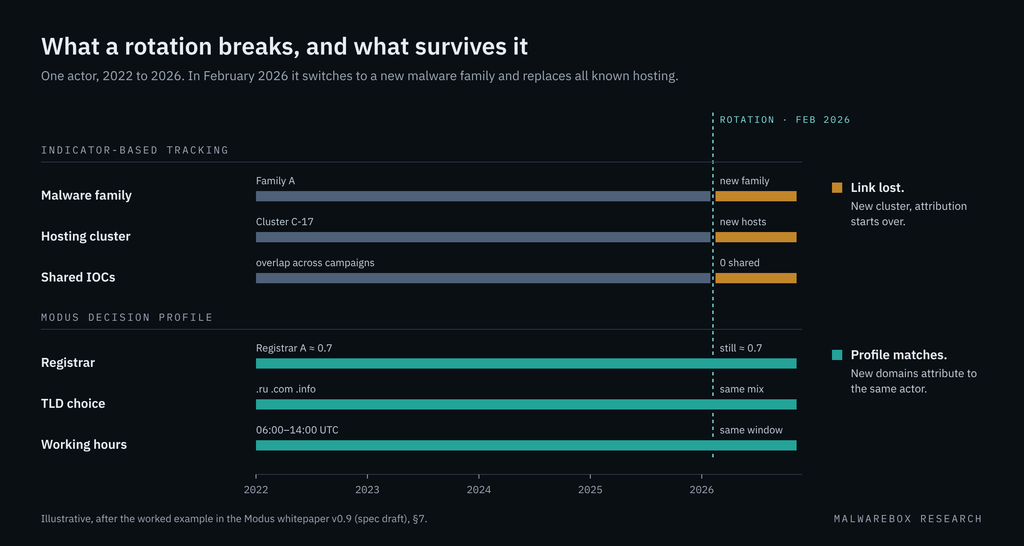
Tools rotate. Infrastructure rotates. Decisions persist.
An actor that always registers through the same registrar isn’t picking at random.
The choice comes from language, payment rails, price and perceived enforcement risk.
Those constraints outlive a malware family and survive a hosting move. Modus turns them into first-class objects in three layers:
- Evidence. Raw, immutable observations: a WHOIS record, a certificate transparency entry, a passive DNS resolution, an IIM chain. Evidence is never edited. A correction is new evidence.
- Decision events. A versioned interpretation rule turns evidence into a claim about a choice, for example “this actor shows a registrar preference for Registrar X”. Every event points to its evidence, the rule and rule version that produced it and a confidence value.
- Profiles. Per-actor distributions over decision events, taken as a snapshot at a point in time and re-derivable from scratch.
The rule versioning is the part I care about most. A rule from 2024 and its 2026 successor may say different things about the same actor. With both pinned, “why did Modus say this in 2024?” has a deterministic answer. It also protects against silent interpretive drift, where analysts slowly change what they count as evidence and the data looks stable while the lens moves.
The v0.9 core has six decision classes: registrar preference, TLD preference, operational hours, registration-to-activation delay, hosting selection and rotation cadence.
Certificate authority preference, payment rails, locale in registration metadata and target-sector concentration are in specification.
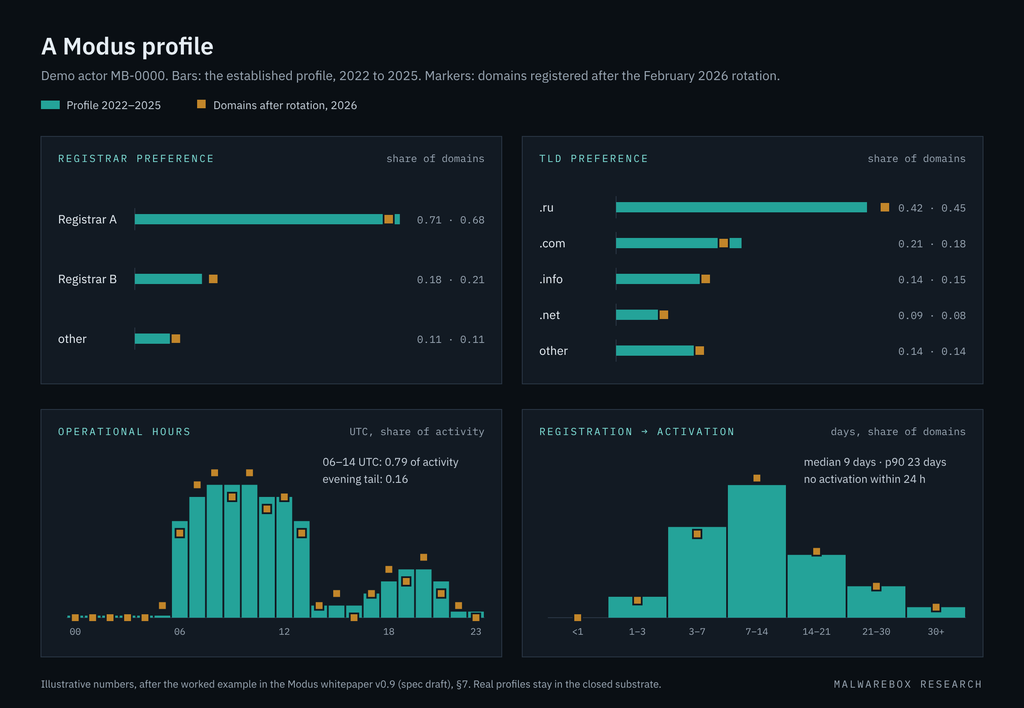
The whitepaper walks through an illustrative case. An Eastern European aligned group with 1,247 attributed domain registrations from 2022 to 2026 yields about 3,800 decision events. In early 2026 the group adopts a new malware family and rotates all known hosting, so tooling fingerprints and infrastructure clusters break off. The new domains still match the old registrar mix, TLD mix, working window around 06:00 to 14:00 UTC and a median activation delay of nine days. The actor changed everything it carried and kept how it bought, when it worked and how long it waited. (The numbers in the paper are representative and don’t come from an operational profile.)
Modus has limits and the paper names them:
- It needs a starting point. Modus extends and stabilises an existing attribution. It doesn’t produce one from nothing.
- Evasion is possible, just expensive. Randomising decisions means changing shift schedules, payment rails and registration providers. State-grade actors with that kind of freedom will show less stable profiles.
- It is only as good as its evidence. WHOIS gaps, uneven passive DNS coverage and collector geography all leak into the result.
- Profile decay is unsolved. 800 registrations at Registrar A, then 50 at Registrar B: a shift, a sub-group or deception? Current recency weighting is provisional.
Why we publish it
We publish the methodology and keep the substrate closed.
The reasons for publishing are simple:
- A standard needs a public text. A method nobody else can read stays a habit. If attribution is going to get a form number, the form has to be public.
- We want it attacked. v0.9 is a spec draft. The claim that decision patterns stay stable through tooling and infrastructure rotation rests on case-level observation and hasn’t been measured at scale yet. That measurement is planned for v1.0 and I’d rather people find the holes before then.
- Anyone should be able to rerun it. Same evidence, same rule version, same profile. Evidence and decision events are signed separately and trust is declared per query, so two organisations can share evidence without having to accept each other’s interpretations.
- Sovereignty. European teams should be able to share evidence and interpretations under their own trust rules, without depending on CTI providers outside European jurisdiction.
What stays closed is the catalogue of decision events for known actors and their profiles. Publishing those would tell actors exactly which of their choices we see and they would randomise exactly those. The method stays useful only as long as nobody is optimising against our specific observations. Access to the substrate goes to vetted partners. The methodology itself costs nothing and carries no licence fee.
Where Modus fits
Modus is one layer in a stack of open models that all sit on top of IIM and share one rule: every score is explainable and every claim keeps its evidence.
- Fathom continuously tracks adversary infrastructure. Most of the evidence Modus reads starts here, though Modus accepts evidence from any signing producer.
- IIM and IIMQL describe infrastructure structurally. IIM treats infrastructure as a noun, Modus treats adversary behaviour as a verb. Both read the same evidence and IIM chains already feed the first Modus rules, for example TLD and platform choices taken from chains.
- SOLBIT scores attribution across six dimensions, weighted by how hard each one is to fake. Modus profiles feed its Operational and Behavioural dimensions, the expensive ones.
- ACDP ranks defensive controls against a specific actor. Knowing how an actor buys, works and rotates tells you which controls actually get in its way.
Read left to right, the models answer four questions:
- who exists in the threat ecosystem,
- who did it,
- which actors matter to you and
- which controls come first.
There are a few more pieces in the stack. We’ll introduce them when they’re ready to be looked at.
If you’re wondering what Fathom is: it’s what Kraken grew into.
Kraken, our actor-centric tracking platform, still does what it always did. It watches adversary infrastructure continuously and keeps an auditable intelligence graph in which every entity can prove where it came from.
It now runs as one module of Fathom, a modular CTI platform in which every module is its own application with its own data. Each one runs on its own and becomes more useful next to the others. Fathom is built for teams that want their intelligence stack on their own infrastructure. We’ll introduce it properly soon.
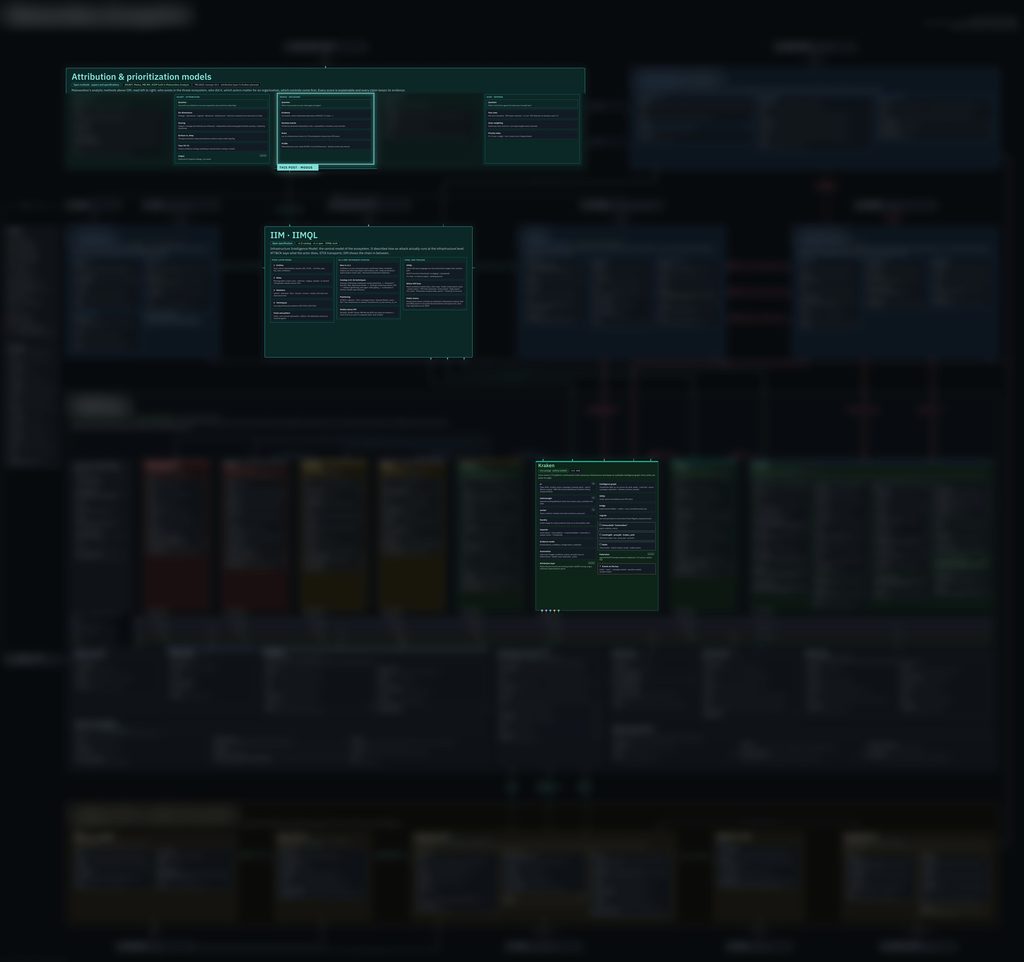
What you’re looking at is the full map of what I have been working on since 2018, built into a coherent intelligence ecosystem.
The sharp parts are already public: IIM and IIMQL, SOLBIT, ACDP, Kraken and as of today Modus.
Everything under the blur exists too.
Most of it is built, some of it is still on paper and all of it runs on the same evidence model you just read about.
We’ll pull it out of the fog one piece at a time, each with its own post and its own paper, starting with MB-RM and PELAGIC.
What comes next
Two more models follow over the next weeks, one post each.
MB-RM, the Malwarebox Relevance Mapper, answers the question defenders actually ask: which threat actors matter for this organisation and why?
An analyst answers a short questionnaire on sector, geography, exposure and observed incidents. Each answer maps to weighted relevance signals, which are matched against actor-specific relevance models. The output is a ranking where every point comes with the matched signals, a rationale and defensive focus areas. No black-box score and no replacement for analyst judgement.
PELAGIC is the threat ecosystem model. Its questions: who acts, who enables it, who orders, controls or funds it and who profits?
It widens our stable MB identifiers from actors to persons, institutions, companies, services and infrastructure. Every claim is its own object with evidence, source dependence and confidence. Time runs on two axes, when something was true and when we knew it. Ten reports quoting the same source count as one origin. Being in the graph is no verdict and bulletproof hosting is the first profile we model with it.
Where it all comes together: Malwarebox Analysis
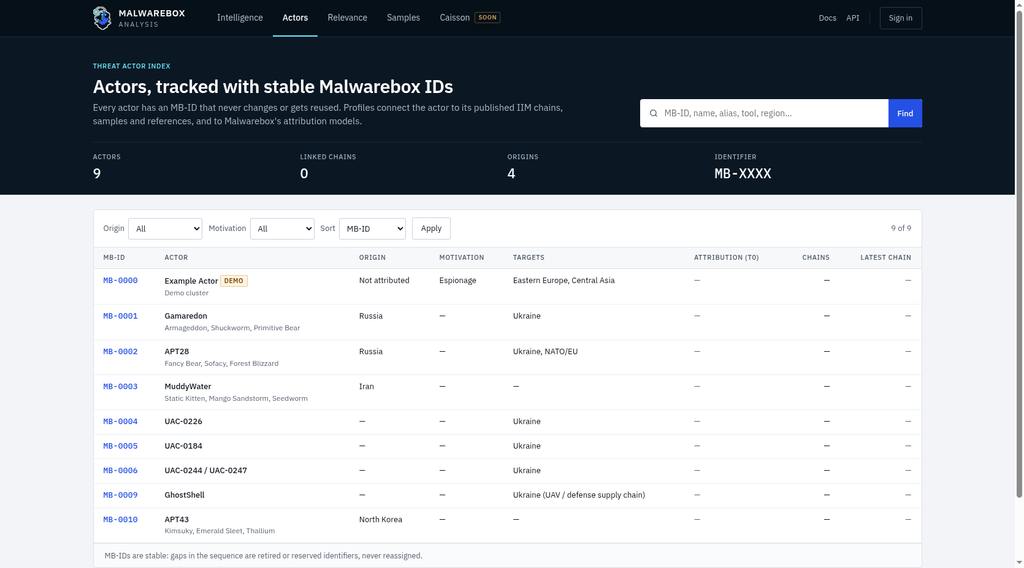
All of these models end up in one place: Malwarebox Analysis, our analysis portal at analysis.malwarebox.eu.
It prepares and serves the data along the methods described on this blog and replaces feed.iim.malwarebox.eu and search.iim.malwarebox.eu, which both move into it.
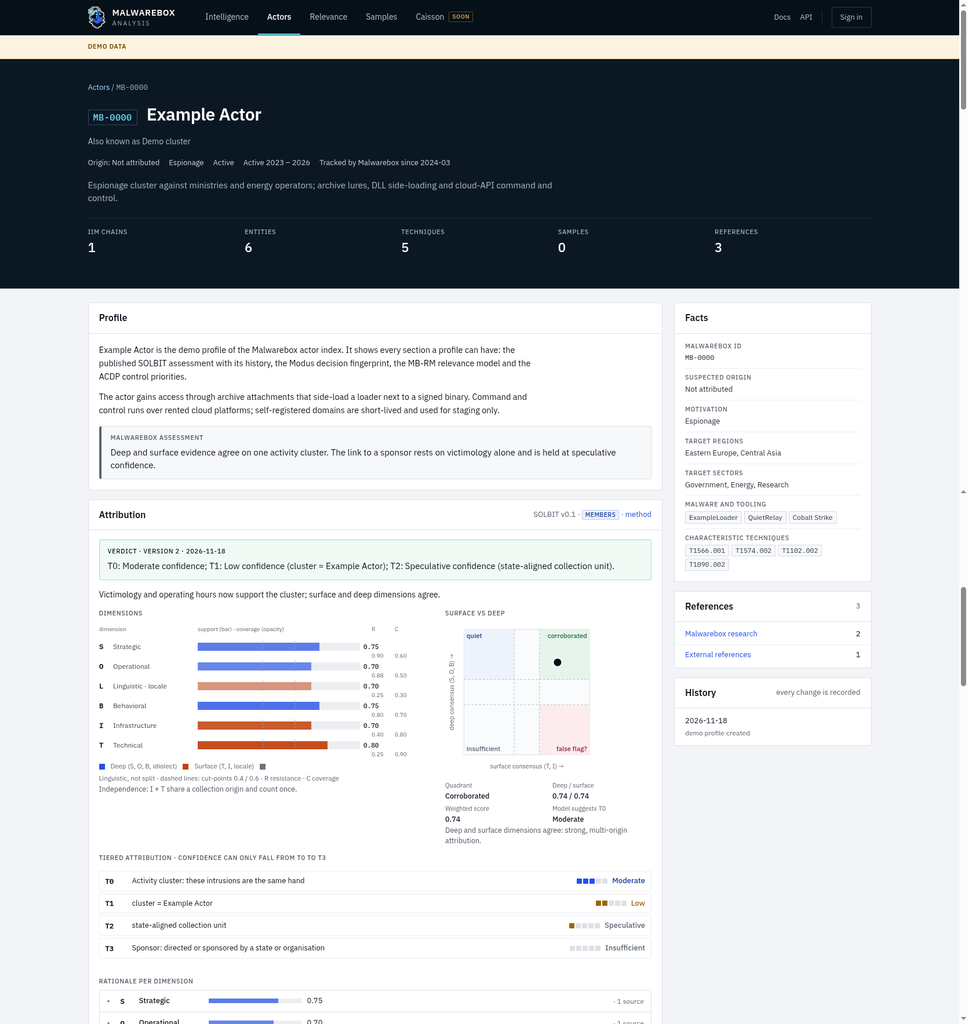
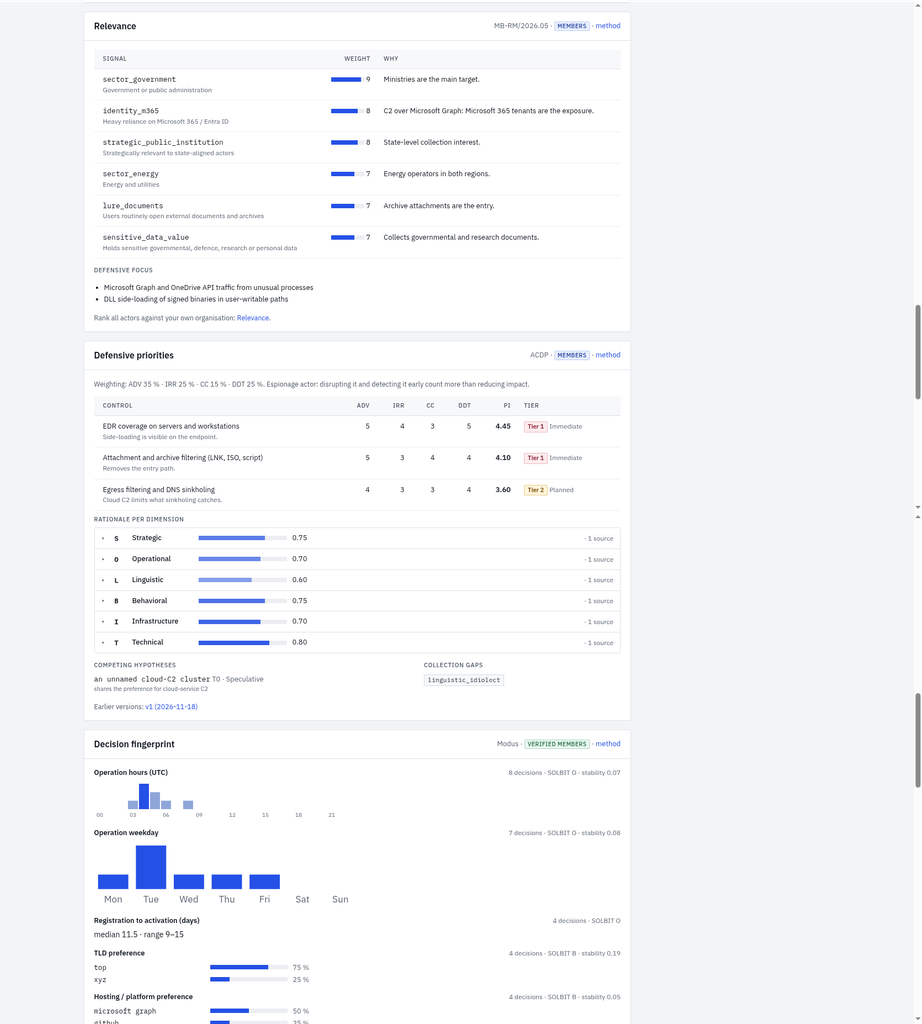
The portal isn’t public yet and launches soon. Here’s a first look.
- Intelligence. The IIM feed and IIMQL search in one page: plain text or IIMQL over published chains, filters for actor, confidence, role and technique, a chain map and a read-only API.
- Threat actor index. Malwarebox IDs that are never reused or renumbered. Each actor profile carries its models: SOLBIT assessments, the public part of its Modus profile, the MB-RM relevance model and ACDP control scores. A methods page lists the exact formulas behind every number.
- Relevance. An organisation answers the MB-RM questions and gets a ranked list of actors, every point explained, followed by the ACDP controls for the most relevant ones.
- Samples. Metadata is public. Downloads are reserved for verified accounts.
The part I’m most excited about is community contribution.
Detailed attribution data can be submitted by the community and is vetted before it lands in a profile.
Vetting works in both directions:
Contributing requires it, and so does access.
Methods, overviews and the public part of each actor profile are open to everyone.
Detailed attribution data is reserved for vetted members, for the same reason Modus keeps its substrate closed: published in full, it tells actors what we see, and it can be misused far outside threat intelligence.
- Member verification. New accounts stay pending until we have verified who is behind them. Verification unlocks both the detailed attribution data and the right to submit. You can be a member under your own name or without a public name; the verification stays between you and us.
- Evidence review. A Malwarebox analyst checks each submission against its evidence and against the existing profile. A claim whose evidence can’t be inspected doesn’t make it in.
- Attributed acceptance. Every accepted claim keeps its evidence, its author and its revision history, and visibility is set per section and per reference.
If you want to contribute research data or apply for access, you don’t have to wait for the launch. Get in touch with me now at contact@malwarebox.eu.
That is the answer to the Holschuld.
In Malwarebox Analysis, attribution is a Bringschuld: The claim arrives at your door together with its evidence, its rules and its version.
Read it, break it
The full whitepaper is here: Modus v0.9 (Zenodo, DOI 10.5281/zenodo.24440318).
Critique is the point of publishing. I’m especially interested in two things:
Decision classes you think are missing or badly cut and cases where an actor’s decision profile clearly did not survive a rotation.
Reach us at contact@malwarebox.eu.
Next up: MB-RM.